

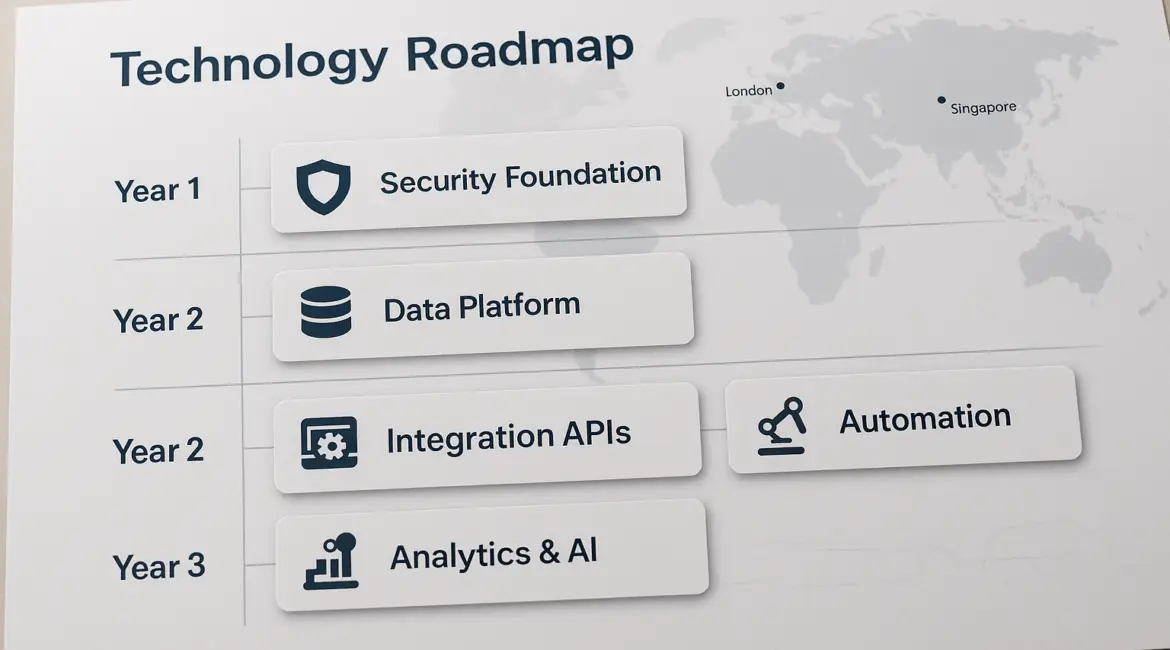
A 3 year technology roadmap is a practical plan that links your business goals to the systems, data, security, and skills you must build over the next 36 months. To create one, you clarify outcomes, assess today’s technology, design target capabilities, then sequence initiatives by value, risk, and capacity. The result is a living roadmap you can fund, staff, and measure.
What a 3 year technology roadmap is and why it matters
A roadmap is more than a list of projects. It is a time-phased strategy that defines the technology capabilities your business needs and the initiatives that deliver them. Over three years, you can modernize core platforms, fix structural risks, and unlock new revenue without destabilizing operations.
In practice, a 3 year technology roadmap helps leaders answer: What are we building, why now, what does it cost, who owns it, and how will we know it worked? It also makes trade-offs explicit, which is critical when budgets tighten or priorities shift.
Start with business outcomes, not tools
Begin by translating business strategy into measurable outcomes. A retailer in Chicago might prioritize faster fulfillment and reduced stockouts; a healthcare provider in London might prioritize patient portal adoption and compliance; a manufacturer in Singapore might prioritize predictive maintenance and OEE gains. Your roadmap should trace every major initiative to outcomes like revenue growth, margin improvement, risk reduction, customer satisfaction, or cycle-time reduction.
Define 3 to 6 outcome themes
Limit themes so the roadmap stays focused. Common themes include:
- Customer experience and digital channels
- Operational efficiency and automation
- Data, analytics, and AI enablement
- Security, privacy, and resilience
- Core systems modernization
- Workforce productivity and collaboration
Each theme should have a clear owner and success metrics that can be reported quarterly.
Assess your current state with a structured inventory
A credible 3 year technology roadmap starts with a fact-based view of what you have. Build a current-state baseline across applications, infrastructure, data, integration, security, and support. For multi-site organizations, include geographic realities such as latency between regions, data residency requirements in the EU, or vendor availability in APAC.
What to capture in the assessment
- Application portfolio: purpose, users, costs, contract terms, end-of-life dates, and business criticality
- Architecture: integrations, data flows, single points of failure, and duplication
- Infrastructure and cloud: hosting locations, scalability constraints, and DR posture
- Data: data quality issues, master data gaps, reporting bottlenecks, and governance maturity
- Security: identity, logging, vulnerability management, third-party risk, and regulatory obligations
- Delivery capability: team skills, tooling, DevOps maturity, and vendor dependencies
Describe the target state as capabilities
Instead of specifying brands too early, define the target state as capabilities. For example: “single customer view,” “zero-trust access,” “near real-time inventory visibility,” or “standardized API integration layer.” Capabilities avoid vendor lock-in and help you compare options later.
Create a simple capability map
List 10 to 20 capabilities across the business. Rate each on current maturity and desired maturity in three years. This highlights where investment is truly needed. A mid-market firm in Toronto might discover it does not need advanced AI immediately, but it does need better data pipelines and identity controls to safely adopt AI in year two or three.
Build initiative candidates and size them realistically
Convert capability gaps into initiatives. Keep them bite-sized and outcomes-oriented. “Implement IAM with SSO and MFA for all apps” is clearer than “Security upgrade.” “Replace legacy CRM” is incomplete unless you include data migration, training, and process changes.
For each initiative, document a one-page brief
- Objective and business outcome linkage
- Scope and key deliverables
- Dependencies (data, integrations, vendors)
- Estimated cost range (capex and opex)
- Staffing model (internal, partner, hybrid)
- Risk level and compliance impact
- Success metrics and acceptance criteria
Use ranges early. Precision is less important than consistency and transparency.
Prioritize using value, risk, and sequencing logic
Most roadmaps fail because everything is “priority one.” Create a scoring model that leadership agrees on. Typical dimensions include customer impact, revenue, cost savings, risk reduction, regulatory need, and effort. Then apply sequencing constraints: foundational work must precede optimization.
Common sequencing patterns that work
- Year 1: stabilize and standardize (security basics, observability, key system upgrades, data governance)
- Year 2: modernize and integrate (platform migrations, API layer, workflow automation, analytics foundation)
- Year 3: optimize and innovate (advanced analytics, AI at scale, personalization, continuous improvement)
This pattern fits many industries, but your geography and regulatory context can shift timing. For example, companies operating across Germany and France often prioritize data residency and privacy controls earlier; organizations with distributed sites in Australia may prioritize network resilience and remote support capabilities sooner.
Translate the roadmap into a quarterly plan with guardrails
A 3 year technology roadmap should be readable at a glance, but it must also be executable. Convert it into a quarterly plan that shows start and finish windows, key milestones, and dependency links.
Add guardrails to prevent overload
- Capacity limits: cap concurrent major initiatives based on team size and change tolerance
- Architecture standards: integration patterns, data definitions, and security requirements
- Procurement cadence: align renewals and RFP timelines to roadmap windows
- Change management: training plans and communication schedules for each release
Guardrails reduce churn and stop “shadow IT” workarounds that add long-term cost.
Budgeting and funding: make costs visible and defensible
Funding a roadmap requires clarity on total cost of ownership. Include licensing, implementation, cloud consumption, support, and the internal time needed for testing and adoption. If your business has multiple regions, incorporate cost variability, such as different labor rates in the United States versus Eastern Europe, or data transfer fees between cloud regions.
Present budgets in three layers
- Run: keep-the-lights-on, support, renewals, and compliance
- Grow: initiatives that expand capacity, enable new channels, or improve customer experience
- Transform: core modernization, major platform changes, and foundational architecture work
This makes trade-offs clearer to finance and helps defend investment during annual planning.
Governance: keep it living, not a one-time document
Roadmaps lose value if they are not maintained. Establish governance that reviews progress, risks, and shifts in business priorities. Tie roadmap updates to quarterly business reviews so technology planning stays connected to reality.
Minimum governance rhythm
- Monthly: initiative status, risks, and dependency management
- Quarterly: KPI reporting, reprioritization, and budget adjustments
- Annually: refresh target state, reassess capability maturity, and extend the plan another year
Governance should include IT, security, finance, and business leaders, plus regional representation if you operate across multiple geographies.
Metrics to prove progress over 36 months
To keep leadership engaged, measure both delivery and outcomes. Delivery metrics include on-time milestone completion, deployment frequency, and defect rates. Outcome metrics should connect to the themes you defined earlier.
Examples of strong outcome metrics
- Reduction in order-to-ship cycle time
- Decrease in support tickets per user
- Improvement in customer NPS or CSAT for digital journeys
- Lowered security incident rate and faster mean time to recover
- Increased forecast accuracy or inventory turns
Use a small scorecard and review it consistently. A focused scorecard is the fastest way to keep a 3 year technology roadmap credible.
Common pitfalls and how to avoid them
- Tool-first planning: start with outcomes and capabilities, then select vendors
- Ignoring change management: budget time for training, communications, and process updates
- Underestimating data work: migration, cleansing, and governance are often the critical path
- Overcommitting: fewer initiatives completed well beats many partially delivered projects
- Weak security foundation: modernize identity, logging, and vulnerability management early
Putting it all together
Building a 3 year technology roadmap is a disciplined exercise in aligning strategy, capability, delivery capacity, and budget. When you define outcomes, baseline your current state, design a capability-led target state, and sequence initiatives with clear governance, you get a roadmap that survives leadership changes and market shifts. With consistent measurement and quarterly refreshes, it becomes an operating system for technology decisions, not a static slide deck.
As you finalize your roadmap, keep the tone professional and pragmatic: prioritize what your organization can absorb, choose standards that will scale across regions, and report progress in business terms. Done well, your roadmap will help stakeholders make confident decisions, reduce avoidable risk, and steadily improve customer and employee experiences over the next three years.
Frequently Asked Questions
Who should own a 3 year technology roadmap in a business?
Who should own a 3 year technology roadmap in a business?
Ownership should sit with a senior technology leader such as the CIO or CTO, with shared accountability across business executives, security, and finance. A 3 year technology roadmap works best when each theme has a business owner, and the PMO or product ops function maintains milestones, dependencies, and quarterly updates.
How detailed should a 3 year technology roadmap be?
How detailed should a 3 year technology roadmap be?
Keep the 3 year technology roadmap high-level at the initiative and capability level, then add quarterly detail for the next two to three quarters only. Include objectives, dependencies, rough costs, and success metrics for each initiative. Avoid locking in vendor decisions too early unless contracts or compliance require it.
How do we prioritize initiatives in a 3 year technology roadmap with limited budget?
How do we prioritize initiatives in a 3 year technology roadmap with limited budget?
Use a simple scoring model that weights business value, risk reduction, regulatory need, and effort, then sequence based on dependencies and change capacity. A 3 year technology roadmap should fund foundational security, data, and reliability early, because these reduce downstream delivery cost and prevent expensive incidents.
How often should we update a 3 year technology roadmap?
How often should we update a 3 year technology roadmap?
Review initiative status monthly and refresh priorities quarterly to reflect performance, new risks, and shifting business goals. Formally extend and recalibrate the 3 year technology roadmap annually by rechecking capability maturity, renewing budget assumptions, and updating major dependencies like contract renewals, hiring plans, and regulatory changes.
What is the difference between a 3 year technology roadmap and an IT project plan?
What is the difference between a 3 year technology roadmap and an IT project plan?
A 3 year technology roadmap explains why and when you will build capabilities to achieve business outcomes, across multiple programs and teams. An IT project plan is execution detail for a single initiative, with tasks, dates, and resources. The roadmap guides funding and sequencing; project plans deliver specific outcomes.