

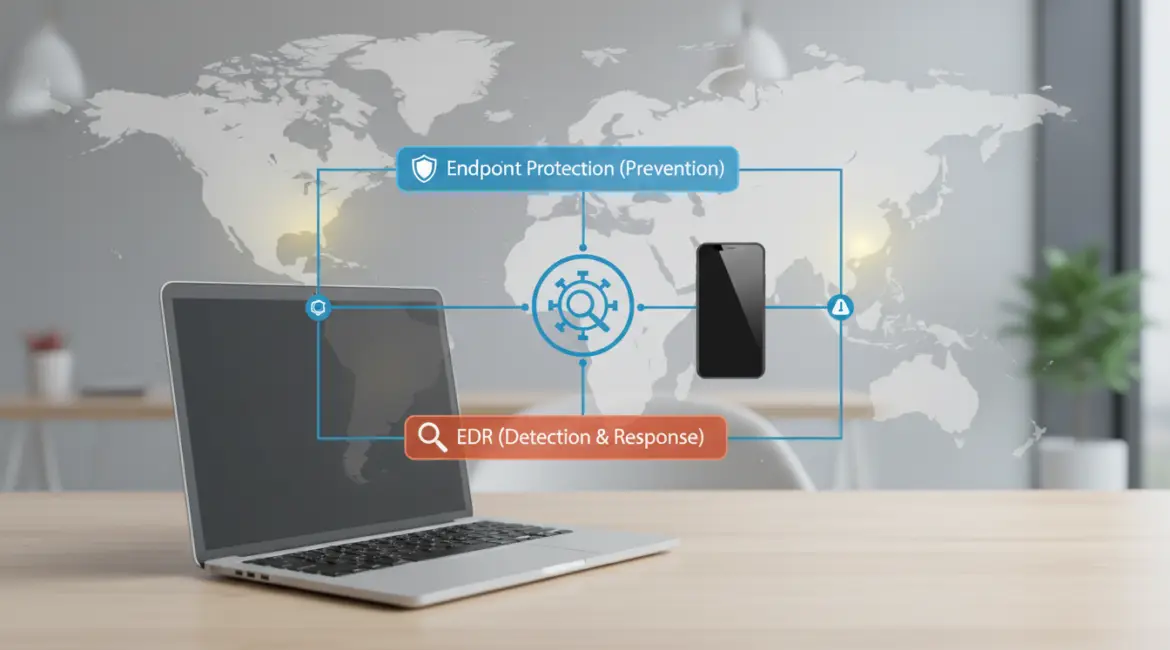
Endpoint protection focuses on preventing malware and unsafe activity on devices, while endpoint detection and response (EDR) focuses on detecting, investigating, and responding to threats that slip through. In endpoint protection vs endpoint detection and response, the real distinction is prevention-first controls versus continuous visibility and response workflows. Most modern security programs benefit from using both, especially in distributed workforces.
Why this comparison matters for modern organizations
Endpoints are no longer confined to a single office network. Laptops move between home Wi-Fi, airports in Atlanta or Chicago, client sites in London, and co-working spaces in Singapore. Phones and tablets frequently access corporate email and SaaS tools from anywhere. This mobility expands attack surface and reduces the reliability of perimeter-only defenses.
When teams evaluate endpoint protection vs endpoint detection and response, they are often trying to solve different problems with one tool: stopping common threats and also handling advanced attacks, insider misuse, and credential-based compromise. Understanding the roles helps avoid gaps, wasted spend, and unrealistic expectations from either product category.
What is endpoint protection?
Endpoint protection is a set of security controls installed on endpoint devices to prevent threats from executing or to block known malicious behavior. It typically includes antivirus or next-generation antivirus features, exploit prevention, device control, web protection, and policy enforcement.
Core goal: prevent and block
The priority is to stop malware and risky actions before they cause harm. Endpoint protection products rely on a mixture of signatures, reputation services, machine learning classifiers, and behavior rules. Many also enforce basic hardening, such as blocking unapproved applications or preventing suspicious scripts from running.
Common endpoint protection capabilities
- Malware detection and quarantine (signature and behavioral)
- Exploit mitigation for common attack techniques
- Web filtering and malicious URL blocking
- Firewall management and device control (USB restrictions)
- Application control and policy-based blocking
- Basic reporting and alerting
Where endpoint protection excels
Endpoint protection is excellent at blocking commodity threats like widespread ransomware campaigns, common trojans, and known malicious files delivered via email or drive-by downloads. It is also strong for organizations that need consistent policy enforcement across many devices, such as school districts across California or healthcare clinics across Ontario, where standardization is essential.
What is Endpoint Detection and Response (EDR)?
Endpoint detection and response is focused on continuous monitoring, detection of suspicious activity, and guided response actions to contain and remediate incidents. EDR tools collect endpoint telemetry such as process execution, command lines, file and registry events, network connections, and sometimes memory indicators, then analyze this data to detect threats and support investigations.
Core goal: detect, investigate, respond
EDR assumes that some attacks will bypass prevention. Its value is in surfacing attacker behavior quickly and enabling an organized response: isolating a device, killing a malicious process, collecting forensic evidence, and rolling back changes or removing persistence mechanisms.
Common EDR capabilities
- Continuous endpoint telemetry collection and searchable event timelines
- Behavior-based detections mapped to tactics and techniques
- Remote response actions (isolate host, terminate process, quarantine file)
- Threat hunting tools and query languages for proactive searches
- Incident investigation workflows and case management integrations
- Integrations with SIEM, SOAR, and identity platforms
Where EDR excels
EDR shines in detecting lateral movement, credential theft, living-off-the-land techniques, and stealthy persistence that may not look like traditional malware. This becomes critical for companies with remote staff spread across New York, Dublin, and Berlin, where a single compromised laptop can provide a bridge into cloud services even when there is no corporate LAN.
Endpoint protection vs endpoint detection and response: key differences
1) Primary objective
Endpoint protection aims to block threats upfront. EDR aims to identify and contain threats that are already active or evasive. In endpoint protection vs endpoint detection and response, prevention is the first line, while detection and response is the safety net and the investigation engine.
2) Data and visibility
Endpoint protection typically provides alerts and basic logs centered around what it blocked. EDR provides deeper telemetry and context that supports root cause analysis. This is the difference between knowing a file was quarantined and understanding the full attack chain, including initial access, privilege escalation, persistence, and exfiltration attempts.
3) Operational maturity required
Endpoint protection can be deployed and managed with smaller security teams, often by IT administrators. EDR is more effective when you have security analysts who can triage alerts, run investigations, and execute response playbooks. Organizations without in-house expertise often pair EDR with a managed detection and response service for 24/7 coverage, especially across time zones like Australia to the US East Coast.
4) Response actions
Endpoint protection can remediate many threats automatically, but it usually has limited tooling for deeper incident response. EDR is designed for hands-on containment and forensics. A common example: endpoint protection blocks a malicious macro, but EDR helps confirm whether the user’s credentials were stolen and whether the attacker touched SharePoint, Google Drive, or an internal server.
5) Metrics that matter
Endpoint protection is often measured by prevention rate and reduction in infections. EDR is measured by time to detect, time to contain, investigation quality, and completeness of remediation. In regulated sectors such as finance in the UK or critical infrastructure in the US, those response metrics directly impact compliance reporting and breach impact.
Do you need both?
In most cases, yes. Endpoint protection handles high-volume, common threats efficiently and reduces noise. EDR provides the depth needed for targeted attacks, insider risk indicators, and post-compromise investigation. If budget forces a choice, align the decision to risk and capability: small organizations with limited security staffing may start with strong endpoint protection, while organizations with higher threat exposure or compliance pressure should prioritize EDR or a managed EDR approach.
How to choose based on real-world scenarios
Scenario A: Small business with mostly SaaS tools
If your company primarily uses Microsoft 365, Google Workspace, and a few cloud apps, endpoint protection plus basic device hardening might address most day-to-day threats. However, if you handle sensitive data, such as legal files in Toronto or client financials in San Francisco, EDR becomes more important because credential theft and session hijacking can bypass traditional malware defenses.
Scenario B: Distributed workforce with frequent travel
For teams traveling through major hubs like Heathrow, Dubai International, or LAX, risky networks increase exposure to phishing, rogue Wi-Fi, and device loss. In endpoint protection vs endpoint detection and response terms, endpoint protection helps prevent drive-by and malware-based attacks, while EDR helps confirm what happened after suspicious activity and enables rapid isolation of a device before cloud accounts are abused.
Scenario C: Hybrid enterprise with on-prem and cloud
Enterprises with data centers in places like Northern Virginia or Frankfurt, plus cloud workloads, need EDR for lateral movement detection and investigation at scale. Endpoint protection remains essential for baseline blocking and policy control. The best results typically come from products that integrate prevention and EDR capabilities under a single agent to reduce overhead.
Implementation tips to get value quickly
Standardize deployment and coverage
Ensure every endpoint is enrolled, including executives’ laptops, contractor devices where possible, and servers where supported. Gaps are common during mergers, such as expanding from Seattle to Vancouver, and attackers target unmanaged devices.
Tune alerts and define response playbooks
For endpoint protection, confirm policy settings match your risk tolerance, especially around scripting, macros, and removable media. For EDR, define who investigates, how to isolate devices, and when to reset credentials. Practice at least one tabletop exercise per quarter, focusing on ransomware and business email compromise paths.
Plan for retention and privacy requirements
EDR telemetry can include sensitive data such as file paths and user activity. If you operate in jurisdictions with strict privacy rules like the EU under GDPR, set clear retention policies, access controls, and documentation. Align with HR and legal teams before broad rollout.
Bottom line
The difference in endpoint protection vs endpoint detection and response is not which is better, but what each is designed to do. Endpoint protection reduces infections and blocks common threats, while EDR provides the visibility and response tooling needed when attackers use stealth, stolen credentials, or novel techniques. A balanced approach, sized to your organization’s risk and staffing, delivers the most resilient endpoint security posture.
To close, treat endpoint security as an operational program, not a one-time purchase. Define your threat priorities, confirm coverage across all locations and remote users, and select tools that your team can run consistently. With clear policies, practiced response workflows, and measurable goals, you can make endpoint protection and EDR work together to reduce both everyday disruptions and high-impact incidents.
Frequently Asked Questions
Is EDR a replacement for endpoint protection?
Is EDR a replacement for endpoint protection?
Usually not. In endpoint protection vs endpoint detection and response, EDR is built for visibility and response, but it does not always provide the same breadth of prevention controls and policy enforcement. Use endpoint protection to block common threats and reduce noise, then rely on EDR to investigate and contain attacks that bypass prevention.
What is the difference between EPP and EDR?
What is the difference between EPP and EDR?
EPP is endpoint protection, focused on preventing malware and enforcing device security policies. EDR is endpoint detection and response, focused on continuous telemetry, detection of suspicious behavior, and guided remediation actions. Endpoint protection vs endpoint detection and response comes down to prevention-first controls versus investigation and containment capabilities.
Can small businesses benefit from EDR?
Can small businesses benefit from EDR?
Yes, especially if you rely heavily on cloud services and face phishing risk. Endpoint protection vs endpoint detection and response is relevant because credential theft and remote access abuse often bypass classic malware defenses. If you lack security staff, choose EDR with managed monitoring so alerts are triaged and response steps are executed quickly.
What should I look for when comparing vendors?
What should I look for when comparing vendors?
Evaluate coverage across Windows, macOS, and servers, plus ease of deployment and alert quality. For endpoint protection vs endpoint detection and response, confirm prevention strength, EDR telemetry depth, and response actions like host isolation. Also check integrations with your SIEM or ticketing tools, and confirm data residency options if required.
How do endpoint tools support ransomware defense?
How do endpoint tools support ransomware defense?
Endpoint protection blocks known ransomware files, malicious macros, and common exploit paths. EDR detects behaviors like mass file encryption, suspicious credential access, and lateral movement, then helps isolate devices and remove persistence. In endpoint protection vs endpoint detection and response, ransomware defense is strongest when prevention reduces exposure and EDR speeds containment.