

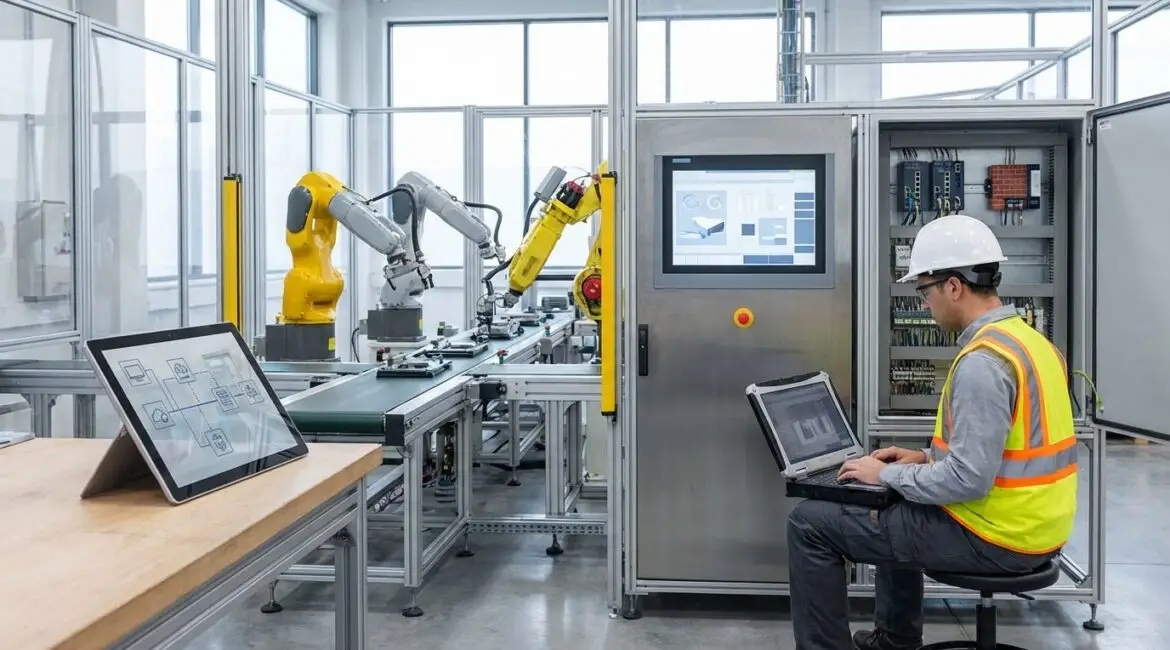
Manufacturers can reduce cyber risk on the shop floor by building visibility into operational technology (OT), segmenting networks, tightening access to machines and engineering tools, and preparing for rapid recovery. The most effective programs focus on production reality: uptime, safety, and legacy equipment, while still applying disciplined security controls across plants, lines, and shifts.
Cyber incidents in manufacturing often start with everyday conditions: a contractor laptop connecting to a cell, an unmanaged switch behind a panel, a shared engineering workstation password, or a remote-access tool added during a rush project. In North America and Europe, where multi-site operations are common, risk scales quickly when the same OT images and credentials are reused across plants. The goal is not to turn a factory into an office IT network, but to apply controls that fit PLCs, HMIs, SCADA, robots, vision systems, historians, MES, and IIoT gateways.
Understand what “shop floor cyber risk” really means
Shop floor cyber risk is the chance that a digital event disrupts production, compromises safety, leaks intellectual property, or degrades quality. Unlike typical IT environments, OT incidents can create physical consequences: unplanned downtime, scrap, equipment damage, or unsafe states. Attack paths frequently blend IT and OT, moving from email or VPN into the plant network and then to engineering workstations or controllers.
Manufacturing sites in regions with dense supplier networks, such as the US Midwest, Germany’s industrial corridors, and parts of Japan, also face heightened third-party exposure. Integrators, OEMs, maintenance vendors, and temporary labor often require access, and each access path needs governance.
Start with OT asset visibility and a realistic inventory
You cannot reduce cyber risk on the shop floor without knowing what you have and how it communicates. Many plants have partial inventories that miss unmanaged switches, wireless bridges, engineering laptops, serial-to-Ethernet converters, or “temporary” remote access boxes that became permanent.
What to inventory first
- Controllers and safety systems: PLCs, safety PLCs, DCS components, SIS interfaces.
- Operator and supervisory systems: HMIs, SCADA servers, historians, MES endpoints.
- Engineering workstations and laptops: programming tools, firmware utilities, backup images.
- Network gear: switches, routers, firewalls, cellular gateways, wireless access points.
- Remote access mechanisms: VPN appliances, remote desktop jump hosts, vendor portals.
Use passive network discovery where possible to avoid disrupting sensitive equipment. Validate with physical walkdowns of cabinets and line-side enclosures. Tie assets to locations and functions, such as “Plant 3, Line 2, filler PLC,” to speed response and reduce confusion during outages.
Segment networks to contain incidents and protect critical cells
Flat networks are a common reason incidents spread. Proper segmentation limits lateral movement and helps reduce cyber risk on the shop floor without slowing operations.
Practical segmentation model
- Separate IT and OT with a well-defined boundary and a monitored industrial DMZ for shared services.
- Segment by cell or area so a problem in packaging does not reach blending or utilities.
- Restrict east-west traffic using VLANs and access control lists, then reinforce with firewalls where needed.
- Control pathways to historians, MES, and quality systems through brokered connections rather than open access.
For multi-site manufacturers across the United States, Canada, and Mexico, standardize segmentation patterns so audits and incident response scale. Document allowed communications for each zone. If your plant relies on legacy protocols, implement “deny by default” gradually, starting with the most critical assets and observing impacts.
Harden access to engineering tools and privileged accounts
Engineering workstations are high-value targets because they can change logic, recipes, and setpoints. Reducing cyber risk on the shop floor requires treating these systems as privileged endpoints.
Controls that work in production
- Eliminate shared accounts on HMIs and engineering stations; move to named users with role-based access.
- Use multi-factor authentication for remote access and for privileged actions where feasible.
- Implement a jump host model: vendors and engineers access OT through a controlled gateway with session logging.
- Time-bound vendor access approvals and require ticket references for emergency connections.
- Disable unused services and remove unauthorized remote tools.
Where internet connectivity is limited or air-gapped segments exist, enforce local policies: strong passwords, account lockout, and periodic credential rotation. For plants in regulated environments, align access practices with IEC 62443 concepts of zones, conduits, and least privilege.
Manage vulnerabilities with OT-safe patching and compensating controls
Patching on the shop floor is different from IT patching. Controllers may require validated firmware, HMIs may be tied to specific Windows versions, and downtime windows may be rare. Still, you can reduce cyber risk on the shop floor by combining planned patching with compensating controls.
A workable vulnerability approach
- Define patch tiers: critical remote code execution fixes first, then privilege escalation, then low-risk updates.
- Test patches in a staging environment or on a noncritical line before broad rollout.
- When patching is not possible, isolate the asset, restrict ports, and monitor traffic for anomalies.
- Track end-of-life assets and build replacement plans into capital cycles.
Focus on the most exposed chokepoints: remote access servers, domain controllers that touch OT, virtualization hosts, and engineering workstations. These often provide the fastest reduction in risk per hour of effort.
Deploy monitoring that detects abnormal OT behavior
Traditional IT detection can miss OT-specific indicators. Effective monitoring combines network-based OT visibility with logs from key systems. The objective is fast detection without overwhelming the team.
Signals to prioritize
- New or rare communications between cells, especially to controller management ports.
- Unexpected PLC program downloads or firmware changes.
- New remote access sessions outside approved hours or from unfamiliar geographies.
- Configuration changes to network devices in OT areas.
For global manufacturers with plants across Europe and Asia, centralize monitoring where practical but keep local runbooks. Local teams know which alarms indicate real production impact and which reflect normal maintenance activities.
Strengthen backups and recovery to minimize downtime
Even with strong prevention, incidents happen. The fastest way to reduce cyber risk on the shop floor is to shorten recovery time: restore operations safely and verify product integrity.
Backup essentials for OT
- Maintain offline and immutable backups of critical servers and virtual machines.
- Back up PLC logic, HMI projects, recipes, and configuration files with version control.
- Store “gold images” for engineering workstations and HMIs to enable rapid rebuild.
- Document restore procedures and validate them during planned outages.
Include spare hardware strategies for hard-to-source components. In regions with longer lead times for industrial parts, such as remote sites in Australia or certain Latin American locations, stock critical spares and validated replacements to avoid prolonged shutdowns.
Train people and formalize procedures that match shift reality
Policies that ignore shift turnover and maintenance practices fail quickly. To reduce cyber risk on the shop floor, training must be short, role-specific, and tied to real scenarios.
High-impact training topics
- How to recognize and report suspicious behavior on HMIs and operator stations.
- Rules for plugging in USB devices and using portable programming tools.
- Vendor access expectations and what to do when a contractor requests exceptions.
- Basic incident steps: who to call, what to isolate, and what not to reboot.
Pair training with simple checklists at the point of work, such as remote access approval steps and line restart verification after a cyber event.
Create an OT-focused incident response plan
Manufacturing incident response must protect safety and product. Develop playbooks for ransomware, unauthorized logic changes, and loss of visibility in SCADA. Define isolation points, such as which firewall rules to activate and which switches to disable, and ensure these actions will not create unsafe conditions.
Run tabletop exercises with operations, EHS, maintenance, IT, and plant leadership. Include site-specific details, such as local emergency contacts and regional regulatory notifications. For example, a facility in the United Kingdom may need to consider NIS-related reporting expectations, while US plants may coordinate with sector resources and local authorities depending on impact.
Measure progress with a few operationally meaningful metrics
To keep momentum, track metrics that production leaders care about. Examples include: percentage of OT assets inventoried, number of unmanaged remote access paths removed, time to restore a critical HMI from backup, segmentation coverage by line, and completion rate of vendor access reviews. These measures connect security improvements to uptime and safety outcomes.
Reducing cyber risk on the shop floor is an ongoing operational discipline, not a one-time project. By combining visibility, segmentation, access control, OT-safe vulnerability management, detection, recovery planning, and practical training, manufacturers can materially lower the likelihood and impact of cyber events while protecting throughput, quality, and safety. A consistent, well-documented approach across plants and regions turns cybersecurity into a reliable part of modern manufacturing performance.
Frequently Asked Questions
What is the fastest way to reduce cyber risk on the shop floor without disrupting production?
What is the fastest way to reduce cyber risk on the shop floor without disrupting production?
Start with OT asset visibility and remove uncontrolled remote access. A passive network inventory plus a review of VPNs, modems, and remote tools often finds quick wins. Then enforce a jump host with MFA for vendors. These steps reduce cyber risk on the shop floor quickly while minimizing changes to PLCs and HMIs.
How should we segment OT networks to reduce cyber risk on the shop floor?
How should we segment OT networks to reduce cyber risk on the shop floor?
Use zones by cell or area, with an industrial DMZ between IT and OT. Limit allowed traffic with VLANs, ACLs, and firewalls at key conduits. Document required protocols for each zone and deny everything else gradually. This containment approach helps reduce cyber risk on the shop floor when an incident occurs.
What if we cannot patch legacy machines, can we still reduce cyber risk on the shop floor?
What if we cannot patch legacy machines, can we still reduce cyber risk on the shop floor?
Yes. If patching is unsafe or unsupported, isolate the asset, restrict ports, block internet routes, and tightly control who can reach it. Monitor for unusual connections and keep verified backups of configurations and logic. Compensating controls like these reduce cyber risk on the shop floor while you plan upgrades.
How do we control vendor and contractor access and still keep maintenance efficient?
How do we control vendor and contractor access and still keep maintenance efficient?
Require all vendor access through a managed pathway: a jump server, time-limited accounts, MFA, and session logging. Approvals should be ticket-based and tied to specific assets and hours. Provide a clear process for urgent break-fix work. This governance helps reduce cyber risk on the shop floor without slowing critical support.
What backups are most important to reduce cyber risk on the shop floor during ransomware?
What backups are most important to reduce cyber risk on the shop floor during ransomware?
Prioritize offline or immutable backups of OT servers, plus versioned backups of PLC logic, HMI projects, recipes, and historian configurations. Keep gold images for engineering workstations and document restore steps that can be executed during an outage. Tested recovery reduces cyber risk on the shop floor by shortening downtime and limiting rework.