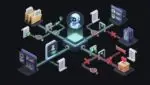


To protect your business from supply chain cybersecurity risks, start by identifying which vendors, software providers, and outside partners could disrupt your operations or expose your data. Then reduce that risk with better vendor screening, tighter access control, ongoing monitoring, and a plan for what happens if one of those partners has a problem.
For many businesses, the weak point is not their own firewall or laptops. It is a payroll provider, cloud application, shipping partner, manufacturer portal, or outsourced IT tool that connects into daily operations. If one outside relationship fails, your business can still be the one dealing with downtime, lost revenue, and difficult client conversations.
What supply chain cybersecurity risk means for a business
Supply chain cybersecurity risk is the risk that a third party introduces security problems into your environment or operations. That third party might be a software company, managed service provider, accounting platform, marketing firm, hardware supplier, or contractor with access to your systems.
In plain English, if another company touches your data, your network, your devices, or an important business process, their security practices matter to you. A breach at their company can become your problem very quickly.
Common examples
- A manufacturer uses a vendor portal for inventory and shipping updates. The portal is compromised, and attackers steal login credentials that also work elsewhere.
- A nonprofit organization relies on a donor management platform. The provider suffers an outage during a fundraising campaign, delaying donations and staff communication.
- A law firm or accounting firm shares sensitive documents with clients through a third-party file platform that was never configured properly.
- A professional services company gives a contractor remote access to internal systems, but the contractor uses weak passwords and no multi-factor authentication.
These situations are common because most organizations depend on outside technology and outside expertise. The issue is not whether you use vendors. The issue is whether you manage that dependency intentionally.
Why supply chain risk deserves executive attention
Supply chain incidents create business problems first and technical problems second. If your ERP system goes offline because a vendor pushed a bad update, production may stop. If your payroll processor is breached, employees may lose confidence and leadership may spend days handling cleanup.
The cost can add up quickly. A 25-person office that loses access to email, files, and line-of-business apps for one full workday can easily lose several thousand dollars in productivity alone. A small manufacturer in Southeast Wisconsin that cannot process orders or print shipping labels may also face delayed deliveries, overtime costs, and strained customer relationships.
For nonprofits and professional firms, the damage may be less about production and more about trust. Donor records, client files, board communications, and financial reports all carry reputational weight.
The biggest supply chain cybersecurity blind spots
Most businesses do not ignore vendor risk on purpose. They simply inherit risk over time as new tools, consultants, and integrations are added.
Blind spot 1: Too many vendors with no clear owner
When software is purchased by different departments, no one has a full picture of who has access to what. Finance may approve one platform, operations another, and HR a third, without a shared review process.
Blind spot 2: Vendors keep access longer than needed
It is common for former consultants, support firms, or software integrations to retain access after a project ends. That creates unnecessary exposure. Access should be reviewed regularly and removed when it no longer serves a business purpose.
Blind spot 3: Security review happens only at purchase time
A vendor that looked acceptable two years ago may have changed ownership, architecture, staffing, or security practices. Risk management is not a one-time checklist.
Blind spot 4: No plan for vendor outages
Even if a third party is not breached, they can still fail. If your business depends on one cloud platform for communication, accounting, scheduling, or donor management, you need a fallback process.
Practical steps to reduce supply chain cybersecurity risks
The goal is not to eliminate all third-party risk. That is not realistic. The goal is to reduce avoidable exposure and make sure one vendor issue does not turn into a business crisis.
1. Build a simple inventory of critical vendors
Start with a list of vendors that meet any of these conditions:
- They store sensitive business or client data
- They can access your systems or accounts
- They support a critical business process
- They connect directly to your network, Microsoft 365, finance tools, or cloud platforms
For each vendor, document what they do, what data they touch, what access they have, who owns the relationship internally, and what would happen if they were unavailable for one day, three days, or one week.
2. Tier vendors by business impact
Not every vendor needs the same level of scrutiny. Your office coffee supplier is not the same as your payroll processor or outsourced IT provider.
A practical approach is to group vendors into high, medium, and low impact categories. High impact vendors deserve deeper security review, contract language, and continuity planning.
3. Ask better questions before signing or renewing
You do not need a 200-question security assessment for every partner. But you should ask enough to understand whether they operate responsibly.
- Do they use multi-factor authentication for staff access?
- How do they handle backups and disaster recovery?
- Do they encrypt sensitive data?
- Who can access your information internally?
- How do they notify customers after a security incident?
- Do they rely on subcontractors or additional third parties?
If you want a broader framework for this process, our article on vendor risk management in IT explains how to evaluate third-party risk in a more structured way.
4. Limit vendor access to only what is necessary
This is one of the most effective controls and one of the most overlooked. Vendors should have the minimum access needed for the job, for the shortest time needed.
That may include:
- Separate vendor accounts instead of shared logins
- Multi-factor authentication
- Restricted admin rights
- Time-limited remote access
- Approval workflows for sensitive changes
Strong identity controls matter here. If your team is still relying heavily on passwords alone, review our related article on secure authentication for practical next steps.
5. Standardize how outside tools connect to your environment
When every department buys and connects tools differently, security gaps multiply. Standardization helps reduce surprises, improve visibility, and make support easier. It also lowers the chance that an old integration remains active long after people forgot it existed.
This is especially important for growing businesses with multiple offices in Northeast Illinois, Kenosha, or surrounding areas where teams may work across branches, warehouses, and remote locations.
6. Prepare for vendor failure, not just vendor compromise
Ask a simple question: if this vendor is unavailable tomorrow, how will we keep operating?
Examples include:
- Manual invoice processing if an accounting platform is down
- Alternate communication methods if a collaboration tool fails
- Offline access to key contact lists and procedures
- Secondary shipping or ordering processes for manufacturers
This is where cybersecurity overlaps with continuity planning. A useful next read is how to create an IT disaster recovery plan for your business.
What good supply chain risk management looks like in practice
A healthy program does not need to be complicated. It needs to be consistent.
For example, a 60-person professional services firm might require security review before any new software purchase, enforce multi-factor authentication for all vendor-connected systems, review third-party access quarterly, and keep a documented fallback process for critical platforms. That is manageable, practical, and far better than hoping vendors have everything under control.
A nonprofit may focus first on donor databases, accounting systems, outsourced IT support, and board communication tools. A manufacturer may prioritize production systems, shipping platforms, supplier portals, and remote support connections. The right priorities depend on how your business actually runs.
How Platinum Systems helps businesses think about this risk
At Platinum Systems, we see supply chain risk as part of a larger business technology strategy. The right response is not panic and it is not buying random tools. It is understanding your dependencies, setting sensible standards, and making sure your business can keep operating when something goes wrong.
That means looking at vendors, identity, recovery planning, access control, and operational processes together. Done well, this reduces avoidable downtime, supports compliance efforts, and gives leadership better visibility into where the real risks are.
Conclusion
Supply chain cybersecurity risks are manageable when you know which outside partners matter most, limit their access, and plan for disruptions before they happen. If you’re ready to strengthen your technology, reduce risk, and plan for the future, contact Platinum Systems to schedule a technology strategy discussion.