

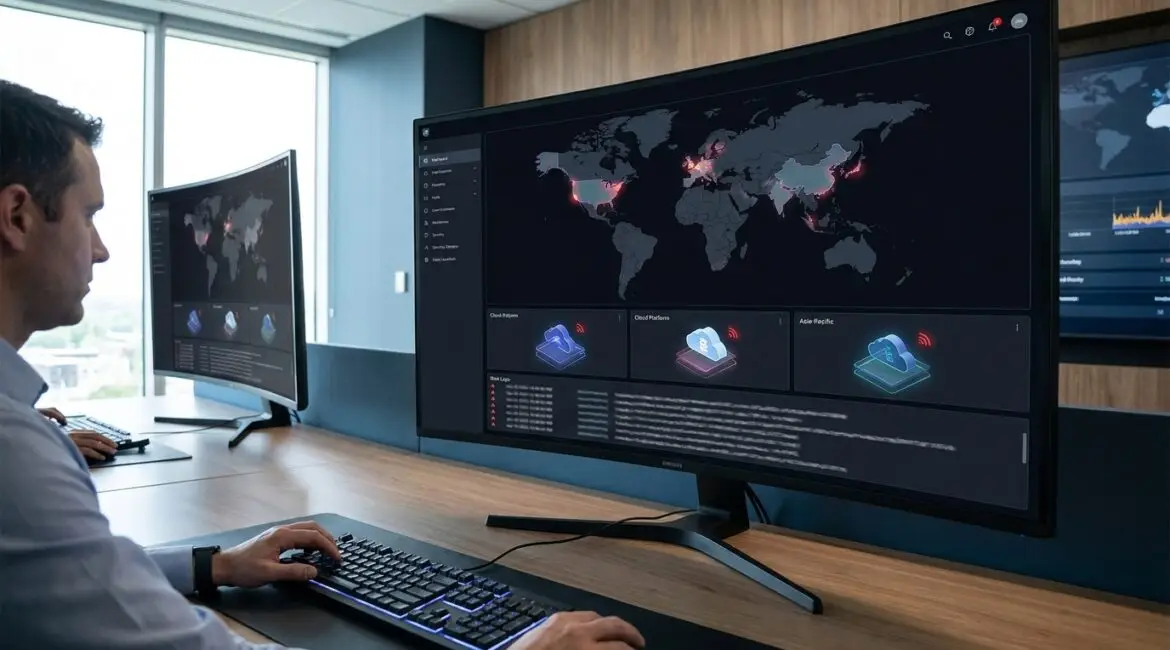
What is cloud security monitoring?
Cloud security monitoring is the continuous collection, analysis, and alerting on security-relevant activity across cloud environments to detect threats, misconfigurations, and policy violations. It is important because cloud infrastructure changes quickly and attackers exploit gaps fast, so you need real-time visibility and response across workloads, identities, networks, and data. Done well, cloud security monitoring reduces breach risk, improves compliance readiness, and shortens incident response times.
Unlike traditional data center monitoring, cloud monitoring must account for elastic resources, managed services, and shared responsibility models. Whether you run applications in AWS us-east-1, Azure West Europe, or Google Cloud in Singapore, the core goal is the same: identify suspicious behavior early and verify that controls remain effective as systems scale and change.
Why cloud security monitoring matters
Cloud adoption has shifted the security perimeter. Teams provision containers, serverless functions, databases, and identity permissions through APIs, sometimes dozens of times a day. This velocity is great for delivery, but it increases the chance of drift: a storage bucket becomes public, a role gains excessive permissions, or a security group opens an unnecessary port to the internet.
Cloud security monitoring matters for four practical reasons:
1) Faster detection of active threats
Attackers often start with credential compromise, then move laterally using IAM permissions and cloud-native APIs. Monitoring authentication anomalies, token use, privilege escalations, and unusual data access helps you spot an intrusion before it becomes a full incident. For example, an unexpected MFA disable event in a North America production account followed by rapid access key creation should trigger immediate investigation.
2) Continuous control validation
Security controls can be correct at deployment and wrong a week later. Continuous monitoring validates encryption settings, logging coverage, network exposure, and identity policies. If a Kubernetes cluster in Frankfurt loses audit logging due to a misapplied config, monitoring should alert before you lose forensic visibility.
3) Compliance support across regions
Many organizations operate in multiple geographies such as the United States, the United Kingdom, Germany, and Australia. Regulations and customer requirements often mandate evidence of logging, access controls, and incident handling. Cloud security monitoring provides audit trails and reports aligned to frameworks like ISO 27001, SOC 2, PCI DSS, and HIPAA, while also helping with data residency considerations when using regional services.
4) Reduced downtime and business impact
Security incidents cause outages, not just data loss. A cryptomining compromise can exhaust compute quotas; a ransomware-style attack can target backups; a misconfiguration can expose an API and trigger abuse. Monitoring that correlates security signals with operational telemetry helps you prioritize incidents that threaten availability and revenue.
What cloud security monitoring covers
Effective cloud security monitoring is broader than scanning for malware. It combines multiple data sources and control planes into a single operating picture. Core coverage areas include:
Identity and access activity
Track sign-ins, API calls, role assumptions, permission changes, key creation, MFA events, and service account use. Identity is the new perimeter, so monitoring identity is non-negotiable across AWS IAM, Azure Entra ID, and Google Cloud IAM.
Configuration and posture
Continuously check resources for risky settings: public object storage, overly permissive security groups, unencrypted disks, exposed admin endpoints, and disabled logging. This aligns with cloud security posture management practices and should include drift detection over time.
Network and endpoint signals
Collect VPC flow logs, firewall logs, load balancer logs, and DNS query logs. For compute, capture EDR-like signals where possible for virtual machines, and runtime telemetry for containers. In hybrid setups, ensure consistent monitoring between on-prem locations and cloud regions.
Application and workload behavior
Monitor application logs for authentication failures, injection attempts, suspicious admin actions, and unusual request patterns. In microservice architectures, correlate traces and logs across services to spot token replay, SSRF attempts against metadata services, and abnormal egress patterns.
Data access and exfiltration indicators
Track who accessed sensitive datasets, from where, and using which tools. Alerts should include large downloads, unusual query volumes, changes to key management policies, and disabling of data loss controls. If a dataset hosted in Dublin suddenly receives heavy access from an unrecognized ASN in another region, that is a strong signal to validate.
How cloud security monitoring works in practice
In practice, cloud security monitoring is a lifecycle: collect signals, normalize them, detect suspicious patterns, respond, and improve. The most reliable programs focus on repeatable engineering, not just dashboards.
Step 1: Collect the right telemetry
Start with control plane audit logs (for example, CloudTrail, Azure Activity Log, and Google Cloud Audit Logs), identity logs, network flow logs, and key application logs. Ensure logging is enabled in every account, subscription, and project, including new ones created through automation. Use centralized log archiving in a dedicated security account with restricted access.
Step 2: Normalize and correlate
Cloud environments generate high-volume events with different schemas. Normalize fields like principal, source IP, region, action, resource, and result. Correlation is where value emerges: tie a suspicious sign-in to subsequent permission changes and data access within a short window.
Step 3: Detect using rules and behavior analytics
Use a blend of detections: baseline rules for known bad events (public bucket creation, disable logging, create access key) plus anomaly detection for rare patterns (impossible travel, new geolocation, unusual time of day, atypical API call sequences). Keep detections tuned per environment, since a development account in Oregon behaves differently than production in London.
Step 4: Respond with playbooks and automation
Monitoring without response increases alert fatigue. Define playbooks for common incidents: compromised credentials, exposed storage, suspicious egress, and privilege escalation. Automate safe actions where appropriate, such as quarantining an instance, disabling a key, forcing password reset, or reverting a risky security group change, while preserving evidence.
Step 5: Measure and improve
Track metrics like mean time to detect (MTTD), mean time to respond (MTTR), alert precision, and logging coverage. Review incidents and near misses to refine detections and close gaps. Over time, shift left by feeding lessons into infrastructure-as-code policies and CI checks.
Common challenges and how to avoid them
Alert overload
Too many alerts reduce trust in the system. Prioritize alerts tied to real risk, enrich them with context, and suppress noisy events. Use severity tiers and route high-confidence alerts to on-call responders while batching low-risk posture findings for daily review.
Blind spots across accounts and regions
Large organizations often have many cloud accounts and regions, including acquisitions or separate business units. Enforce standardized logging and monitoring onboarding for every tenant. Periodically inventory accounts, subscriptions, and projects, and confirm telemetry from each region, such as Tokyo, Sao Paulo, or Paris, is flowing to central analytics.
Shared responsibility confusion
Cloud providers secure the underlying infrastructure, but customers remain responsible for identity, data, configuration, and many network settings. Align monitoring to your responsibilities and verify managed services are configured securely, including database auditing, key management, and access logs.
Lack of operational ownership
Define who owns detections, who responds, and who fixes root causes. A strong model is a partnership: security engineering builds detections and automation, a SOC or on-call team responds, and platform teams remediate infrastructure issues through code changes.
Choosing tools and building a monitoring stack
You can implement cloud security monitoring with cloud-native services, third-party platforms, or a hybrid approach. Cloud-native tools integrate quickly and understand provider events, while third-party platforms can unify multi-cloud telemetry and add advanced analytics. Many organizations run a SIEM for central correlation plus a SOAR tool for response automation, combined with posture management and runtime protection for containers and VMs.
When evaluating tools, focus on practical capabilities: multi-account onboarding, cross-region log collection, detection library quality, data retention and search performance, integration with ticketing and incident tools, and support for compliance reporting. Also consider data residency and sovereignty needs; some organizations in the EU prefer keeping security logs within EU regions, while global companies may centralize in the US with appropriate controls and contractual safeguards.
Best practices to get immediate value
Start with high-impact detections
Begin with a small set of alerts that catch common, high-risk events: logging disabled, public storage created, access key creation by unusual principals, IAM policy changes, new admin users, security group exposure of SSH or RDP, and unusual data downloads. Validate each alert with a clear response action.
Centralize identity visibility
Consolidate identity logs and enforce strong authentication. Monitor for risky OAuth app consent, unusual token use, and anomalous sign-ins. For distributed teams across New York, Toronto, and Bangalore, implement conditional access patterns and monitor exceptions closely.
Protect the monitoring pipeline
Attackers may try to disable or tamper with logs. Use separate security accounts, immutable storage options, restricted IAM, and alerts on any changes to logging configurations. Ensure log delivery is monitored so you notice gaps immediately.
Integrate with engineering workflows
Send posture findings to the teams that can fix them, ideally as tickets linked to infrastructure code. Include reproducible evidence: resource IDs, timestamps, regions, and suggested remediation. This turns cloud security monitoring into continuous improvement rather than a separate security silo.
Conclusion
Cloud security monitoring is the operational backbone of secure cloud adoption, providing continuous visibility into identity, configuration, network, workload behavior, and data access. By collecting the right telemetry, correlating signals across regions, and responding with well-tested playbooks, organizations can detect threats earlier, prove compliance more easily, and reduce the business impact of incidents. With a focused set of high-value detections and disciplined ownership, cloud security monitoring becomes a practical, scalable capability that supports both security and delivery goals.
Frequently Asked Questions
Is cloud security monitoring only needed for large enterprises?
Is cloud security monitoring only needed for large enterprises?
No. Cloud security monitoring is valuable for startups and mid-size teams because cloud environments change quickly and small misconfigurations can expose data. Start with a minimal set of alerts for public storage, IAM privilege changes, and logging disabled events, then expand coverage as you add services and regions.
What logs should I enable first to support cloud security monitoring?
What logs should I enable first to support cloud security monitoring?
Prioritize control plane audit logs, identity provider sign-in logs, and network flow logs. These provide the fastest wins for cloud security monitoring because they show who did what, from where, and what changed. Centralize logs in a separate security account and alert on any gaps in log delivery.
How does cloud security monitoring help with compliance audits?
How does cloud security monitoring help with compliance audits?
Cloud security monitoring creates searchable evidence of access, changes, and security events across accounts and regions. For audits like SOC 2 or ISO 27001, it helps demonstrate logging, least privilege enforcement, and incident response execution. Keep retention policies aligned to requirements and export key reports regularly.
Can cloud security monitoring work across AWS, Azure, and Google Cloud?
Can cloud security monitoring work across AWS, Azure, and Google Cloud?
Yes. Cloud security monitoring can be multi-cloud by collecting native audit logs from each provider, normalizing fields, and correlating events in a central SIEM. Use consistent detection patterns for IAM changes, public exposure, and data access anomalies, while still accounting for provider-specific services and terminology.
What is the difference between cloud security monitoring and CSPM?
What is the difference between cloud security monitoring and CSPM?
CSPM focuses on configuration posture and compliance checks, while cloud security monitoring focuses on continuous event detection and response. In practice they complement each other: CSPM flags risky settings like public buckets, and cloud security monitoring alerts when someone creates that bucket or accesses sensitive data unexpectedly.